This Guide translates official NZQA Performance standards and assessment Specifications into a strategic roadmap. Use it to Prepare for the digital external examination.
The Core Strategy
The New Zealand Scholarship Digital Technologies assessment is a 3-hour, end-of-year digital examination.
You will be given three Programming problems. For each problem, you must Provide a full written response detailing your technical approach.
Exam Mechanics
- Environment: You will type your solutions directly into an approved Online examination portal.
- Restrictions: You will not be able to run, compile, or debug your code. You must trace logic entirely in your head or on the provided scratch paper (note: scratch paper is not marked).
- Languages Allowed: Python 3, JavaScript, Java, C, C++, or C#. Stick to one language throughout the exam.
Scoring Structure
Every question is evaluated across three core criteria. To achieve a Scholarship mark, you must excel in the first three columns. To hit Outstanding Scholarship, your answers must consistently demonstrate the traits in the final Column:
| 1. Algorithmic Comprehension | 2. Development & Implementation | 3. Critical Reflection | 4. Outstanding Elements |
| Decomposing a Complex problem into sequence, selection, and Iteration. | Designing, writing, and manually Debugging a complete, syntactically sound solution. | Evaluating time/space complexity, edge cases, cost, and real-world implications. | Showing deep perception, high-level abstraction, scalability, and convincing communication. |
Question Framework
Every question expects a structured answer broken into four progressive phases:
[Phase 1: Decomposition] ──> [Phase 2: Algorithm Design] ──> [Phase 3: Code Implementation] ──> [Phase 4: Critical Analysis]
Phase 1: Decomposition & Planning
Don’t jump straight to coding. Define the Inputs, Outputs, Constraints, and Data structures. Explicitly state how you are breaking down the Complex problem into smaller sub-problems.
Phase 2: High-Level Algorithm Design
Provide a structural overview of your solution using clean Pseudocode, structured English, or architectural notes. Highlight the structural workflow (e.g., using a sliding window approach, breadth-first search, or Dynamic Programming).
Phase 3: Code Implementation
Write clean, readable code in your chosen language. Because you cannot compile it, focus heavily on Variable naming, avoiding off-by-one errors in loops, and ensuring structural correctness.
Phase 4: Critical Reflection & Analysis
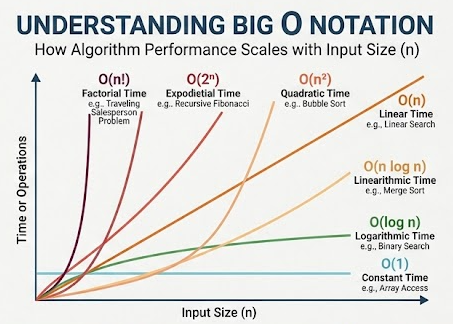
This is where Scholarship points are won or lost. You must critically evaluate your own Design. Analyze its computational efficiency using Big O notation ($O(N)$, $O(N \log N)$, etc.) for both time and space. Detail how your solution scales if the dataset grows to millions of records, outline potential edge cases (e.g., null values, extreme Inputs), and suggest alternative approaches you chose not to use and why.
Example Exam Questions & Master Solutions
Example 1: Stream Analysis & Sliding Window
Problem Statement: A high-frequency financial logging System tracks stock transactions as an incoming stream of prices. You are given an Array of integers prices and a window size k. Write a System that calculates the maximum price within every moving window of size k as it slides across the Array from left to right.
Example: prices = [1, 3, -1, -3, 5, 3, 6, 7], and k = 3.
The moving windows and their max values yield the output: [3, 3, 5, 5, 6, 7].
1. Algorithmic Comprehension & Decomposition
- Inputs: An Array of integers
pricesof size $N$; an Integerk($1 \le k \le N$). - Outputs: An Array of integers representing the maximums of length $N – k + 1$.
- Constraints/Scale: The Array can contain up to $10^6$ elements. A brute-force approach checking all $k$ elements for every window position will yield a time complexity of $O(N \times k)$, which will fail under massive scale.
- Decomposition:
- We must maintain a tracking System for elements within the current window.
- We Need a way to discard elements that are no longer useful: either because they fell outside the left boundary of the sliding window, or because a newer, larger element has entered the window (making older, smaller elements irrelevant).
2. Algorithm Development (High-Level)
To optimize this to $O(N)$ linear time, we can utilize a Monotonic Deque (Double-Ended Queue). The deque will store the indices of the Array elements. It will be maintained in a strictly decreasing order of their corresponding values.
- For each element at index
i, remove indices from the back of the deque if their corresponding value is less than or equal toprices[i]. - Add the current index
ito the back of the deque. - Remove the index from the front of the deque if it falls outside the window boundary (
i - k). - Once the first window is fully formed (
i >= k - 1), the element at the front of the deque is always the maximum for that window.
3. Code Implementation (Python 3)
Python
from collections import deque

def max_sliding_window(prices: list[int], k: int) -> list[int]:
    if not prices or k == 0:
        return []

    result = []
    win_deque = deque()  # Stores indices

    for i in range(len(prices)):
        # 1. Remove indices of elements out of the current window's left bounds
        if win_deque and win_deque[0] < i - k + 1:
            win_deque.popleft()

        # 2. Maintain monotonic property: remove smaller elements from the back
        while win_deque and prices[win_deque[-1]] <= prices[i]:
            win_deque.pop()

        # 3. Add current element's index
        win_deque.append(i)

        # 4. Append the max element of the window to the results
        if i >= k - 1:
            result.append(prices[win_deque[0]])

    return result
4. Critical Reflection & Analysis
- Efficiency Analysis:
- Time Complexity: $O(N)$. Even though there is a nested
whileLoop, each element is pushed into the deque exactly once and popped out at most once over the execution of the entire Algorithm. This scales linearly, representing a massive optimization over the $O(N \times k)$ brute-force approach. - Space Complexity: $O(k)$ auxiliary space to store the indices within the deque.
- Time Complexity: $O(N)$. Even though there is a nested
- Scalability & Abstraction: In a real-world enterprise financial architecture, this logic could be integrated into a stream processing framework (like Apache Flink). By working with indices rather than object references, memory overhead is kept to an absolute minimum.
- Edge Cases: If $k = 1$, the Loop naturally appends every element. If all prices are strictly increasing, the
whileLoop continuously clears the queue, maintaining a queue size of 1 and executing flawlessly.
Example 2: Resource Allocation & Dynamic Programming
Problem Statement: A cloud platform allocates server instances to handle client tasks. Each instance has a set memory capacity C. You are given an Array of integers tasks, where each Integer represents the memory requirement of a unique, indivisible process. Determine the absolute minimum number of server instances required to process all tasks concurrently.
Example: tasks = [4, 8, 1, 4, 2, 1], C = 10.
Optimal allocation: Server 1: [8, 2] (Sum 10); Server 2: [4, 4, 1, 1] (Sum 10). Total Servers = 2.
1. Algorithmic Comprehension & Decomposition
- Core Problem: This is a classic Bin Packing Problem, which is NP-hard. An exact optimal solution requires exploring exponential combinations, while large-scale deployments require highly efficient Heuristic approximations.
- Decomposition:
- Sort tasks to prioritize highly demanding resource requests first.
- Evaluate existing open Servers to see if they can accommodate the current task.
- Instantiate a new server only when existing active Servers lack space.
2. Algorithm Development (High-Level)
We will implement the First-Fit Decreasing (FFD) Heuristic strategy.
- Sort the Array
tasksin descending order. - Maintain a Dynamic list
Serverswhere each entry tracks the remaining available capacity of an active server. - Iterate through each task. For each task, scan the
Serverslist from left to right. Place the task in the first server that has a remaining capacity greater than or equal to the task’s size. - If no server can hold the task, append a new server to the list initialized with a capacity of
C - task_size.
3. Code Implementation (JavaScript)
JavaScript
function minServersRequired(tasks, C) {
    if (!tasks || tasks.length === 0) return 0;

    // Sort tasks in descending order
    let sortedTasks = [...tasks].sort((a, b) => b - a);

    // Array to track the remaining capacity of each active server
    let servers = [];

    for (let i = 0; i < sortedTasks.length; i++) {
        let task = sortedTasks[i];

        // Edge case validation: a single task exceeds total container capacity
        if (task > C) {
            throw new Error(`Task size ${task} exceeds maximum server capacity ${C}`);
        }

        let placed = false;

        // Find the first server that can accommodate this task
        for (let j = 0; j < servers.length; j++) {
            if (servers[j] >= task) {
                servers[j] -= task;
                placed = true;
                break;
            }
        }

        // If it doesn't fit in any existing server, spin up a new one
        if (!placed) {
            Servers.push(C - task);
        }
    }

    return Servers.length;
}
4. Critical Reflection & Analysis
- Efficiency Analysis:
- Time Complexity: $O(N \log N)$ for sorting, plus a worst-Case nested search of $O(N^2)$ if every task requires a brand-new server. Total worst-Case time is $O(N^2)$.
- Space Complexity: $O(N)$ to hold the allocated Servers list and the sorted Array copy.
- Heuristic Trade-offs & Optimizations: While FFD does not guarantee the mathematical absolute minimum in 100% of hypothetical cases, it is guaranteed to use no more than $\frac{11}{9}\text{OPT} + 6.87$ bins. This makes it incredibly efficient for real-time cloud resource allocation where waiting for an exact exponential Algorithm to finish calculating is unacceptable.
- Algorithmic Extrapolation: To scale this up to handle millions of tasks, scanning the
Serverslist linearly ($O(N^2)$) becomes a bottleneck. We could optimize the lookup to $O(N \log N)$ by storing the Servers in a Max-Heap or a Balanced Binary Search Tree ordered by their remaining capacity.
High-Performance Exam Rituals
To lock in a top mark on exam day, practice these strategies while writing your answers:
- Explicitly state your assumptions: If a question doesn’t state whether Inputs can be negative or if the Array can be empty, write: “Assumption: The input dataset contains only positive non-null integers.” This protects your logic from being penalized for structural ambiguity.
- Comment your code like an engineer: Since your code won’t run, use Brief inline comments to prove to the marker that a line of code is intentional (e.g.,
# Base Case: empty node return). - Structure your reflections with headings: Do not present a wall of text for your Critical evaluation. Use explicit sub-headings like
### Time Complexity Analysis,### Edge Cases & Mitigations, and### Structural Scalabilityto make your answer easy to scan and mark.
Additional Resources and Further Information
-
Bubble Sort
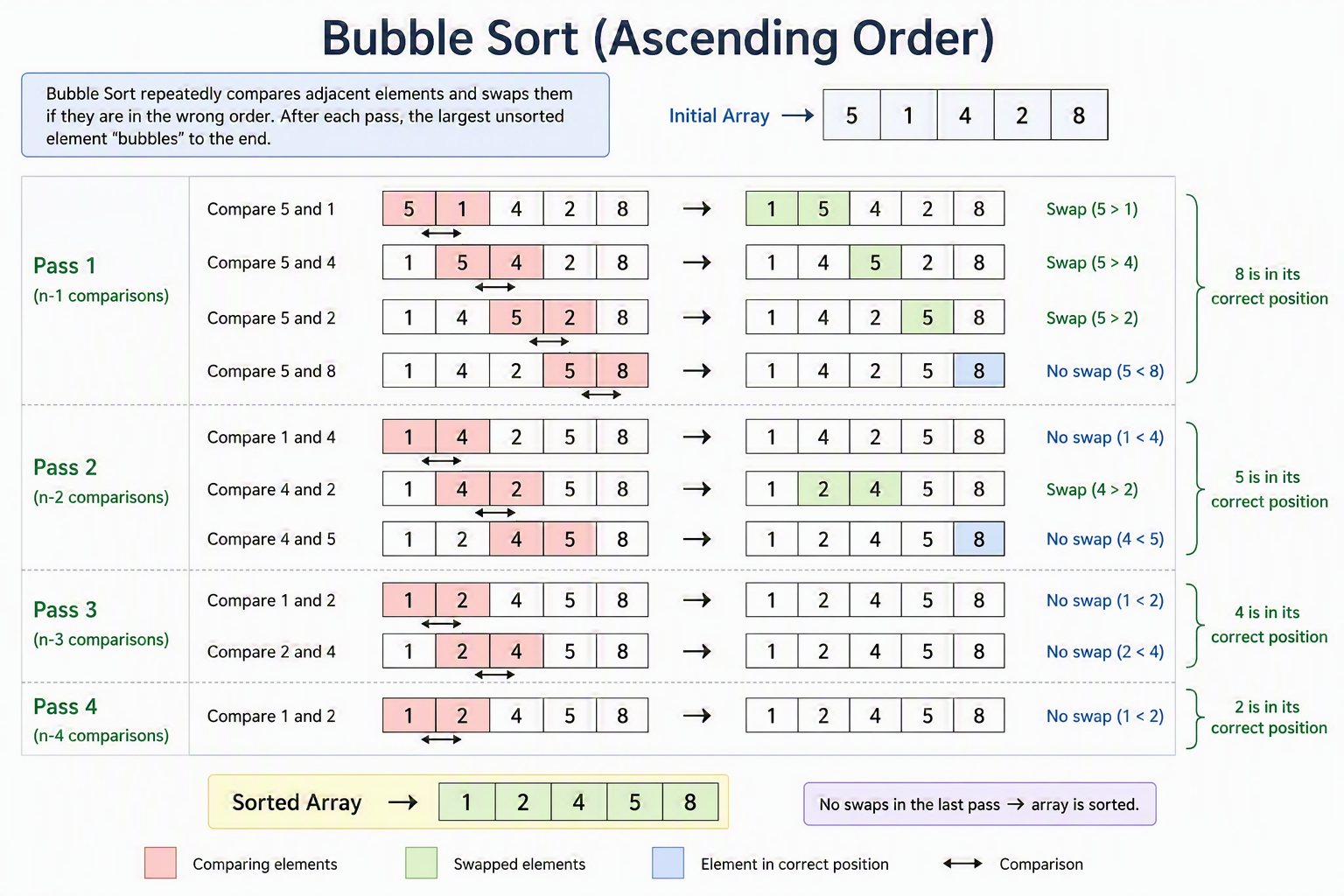
Imagine you have a Row of unsorted colored blocks, and you want to line them up from shortest to tallest. Bubble sort is a game where you only look at two blocks next to each other at a time. Here is how you play: The Line-Up Game By the time you reach the end of…
-
Big O Notation and Algorithmic Complexity
Big O notation measures how the resource requirements of an Algorithm—specifically running time and memory space—grow asymptotically as the input size ($N$) approaches infinity. Instead of measuring execution in seconds or bytes (which change based on hardware), Big O focuses entirely on the growth rate of the operations relative to input growth. Fundamental Mathematical Rules…