When working on NCEA Digital Technologies achievement standards, understanding relevant implications and how the command words (Identify, Describe, Explain, and Address) build upon each other is crucial for reaching Achieved, Merit, or Excellence.
The key here is that it must be relevant to the Outcome being produced. For example Risk of electrical shock wouldn’t be a relevant Implication in relation to developing a website but it would be relevant for assembling a computer from components.
What Are “Relevant Implications”?
Relevant implications are the real-world considerations, requirements, or Constraints that you must take into account when designing and building a Digital Outcome. They Ensure your Project is fit for its intended purpose, Legal, and ethical.
- Accessibility
- Aesthetics
- Cultural
- End User Considerations
- Ethical
- Functionality
- Future Proofing
- Health and Safety
- Intellectual Property
- Legal
- Privacy
- Social
- Sustainability
How to answer: A Step by Step Breakdown:
To perform well in NCEA, you must understand how these terms progress from Basic definitions to concrete Design choices.
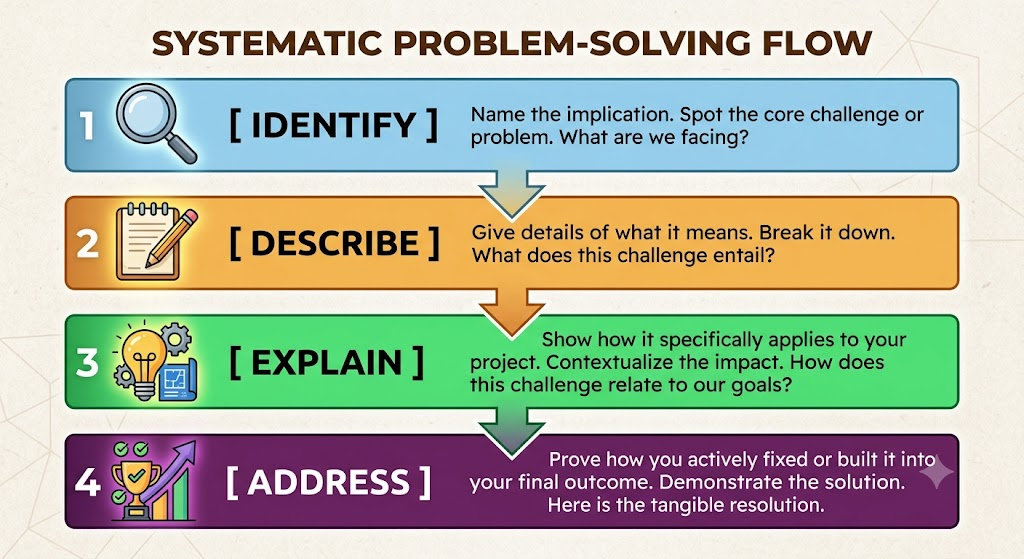
1. Identify (The “What”)
- Definition: To name or point out a specific Implication that matters to your Project. This is just the starting label.
- Example: “A relevant Implication for my login System database is Privacy.”
2. Describe (The “More Detail”)
- Definition: To give a thorough definition or account of what that Implication means in general terms.
- Example: “Privacy means that personal user information, like names and passwords, must be protected so that unauthorised people cannot access it.”
3. Explain (The “Why & How it Applies”)
- Definition: To connect the Implication directly to your specific Digital Outcome. You must outline how it applies to your Context and what your Outcome needs to do or include to meet it. This is standard at Level 2/3 for passing grades.
- Example: “Because my login System stores student passwords, Privacy applies directly to my database. If the database is hacked, student accounts could be compromised. Therefore, my Outcome needs to Ensure that passwords are encrypted or hashed before storing them, rather than saving them in plain text.”
4. Address (The “Action/Proof”)
- Definition: To show physical or documented evidence that you actually mitigated against or solved the Issue during development. You must prove that your Design choices directly handled the Implication.
- Example: “To Address the privacy implications, I implemented a secure SHA-256 hashing Algorithm in my Python server backend. When a user signs up, their plain-text password is converted into a secure hash before being written to the database. I verified this worked by taking a screenshot of the database table, showing that the passwords appear as random strings of characters.”